The Blog
Writing craft, product updates, and thoughts on the creative process.

If you are a new writer there is one piece of advice you need to hear first, above anything else I or anyone else can give you. Your first draft sucks. No qualification, no buts — go back and read that again a few times. Go ahead, I'll wait. Done? Good. Now let me explain why that's the point and not a consequence.Your First Draft is Marble, Not a StatueYour first draft is the essence of a story. It's the idea you had in your mind when you sat down at the keyboard to begin. It's raw, emotional, all over the place, probably loops back on itself several times, makes no sense in parts, changes genre in others, and is similar to the slab of marble a sculptor starts with before they make their masterpiece. That's not to say you shouldn't be incredibly proud of finishing it. You absolutely should. Eighty percent of aspiring authors never make it there. But don't hold it up as though it needs to be perfect. It's in its infancy and it needs you, the author, to raise it.Internalize that idea because it's going to be the backbone for every decision you make while writing your novel. When you accept that you are allowed to make mistakes, not just allowed but encouraged, you will be free from the handcuffs of perfection. Perfection is where every idea, great, good, bad, and ugly, goes to die. You'll be free from the worry that someone might read that shameless or terrible idea that later turns out to be the core of the plot. Most importantly, it'll free you from the dreaded writer's block, because you will feel free to write anything that comes to mind, even if it's incoherent nonsense.When you write your first draft, whether from an outline ([url='https://www.quillloop.com/blog/should-you-take-your-pants-off-to-write']see why you should use an outline[/url]) or by the seat of your pants, you should be exploring your story. Wander into that plotline where the main character gets shot. Muse about what happens when the antagonist decides to start a cult and converts your main character's best friend. For me, I always write myself into the worst possible corner and try to write my way back out. Does it always work? Gosh no. Is it fun? You bet. Some of my best ideas have come from giving myself the freedom to make mistakes.Banish the Spell CheckerSo what does that actually look like in practice? Start by ignoring your spell checker entirely.Spell checkers are for the editing phase, and even then only when you're ready for your first round of beta readers. A good portion of what you write in your first draft will never make the final cut, so there is no reason to polish prose that will never see the light of day. Worse still, every moment you spend on spelling is another moment away from your flow, another chance to get distracted and lose your place. Who cares if you misspelled your character's name? You can fix that later. You won't forgive yourself if you forget the perfect way to get your main character's best friend out of the cult leader's house under cover of night.Write Every Day, Even if it's Three WordsIt may not feel practical to carve out an hour every day, and that's okay. For many writers, writing time is 15 minutes on the train to work, five minutes in the car before going inside, or an hour on weekends while the kids are outside playing. The important thing is that you use those moments and use them wisely. When you sit down to write, write. Don't get distracted by research, that can come later. Don't check your email. Just write. Write whatever comes to mind. If you're not in the mood for your current chapter, skip it and start the next one. Revision will catch the narrative inconsistencies later. Right now you need to get the story down.Leave Yourself a Breadcrumb for TomorrowOne thing I've found valuable is jotting down where my head was at when I left off. I'm not talking about an essay, just two or three bullets about what you were thinking when you wrote what you did, where you're going, and why. Those bullets can pull you back into your headspace so your next session gets productive faster.The Enemy of Good is PerfectWrite down anything and everything. Bad ideas written down can become good ones, and the truly awful ones get cut later. I like to think of writing as thought blogging, just getting ideas down on the page and sorting them out in the wash. You'll be amazed at where your mind goes when you stop worrying about making it perfect and start just doing the craft.Writing is equal parts frustration and fun. You're going to have days you wonder why you started and others where you're over the moon. Ride the highs and hack through the lows. Never put that pen down, because it's worth it when you finally get to write the words "The End."The only difference between a dreamer and an author is the tap of keys or the stroke of a pen.
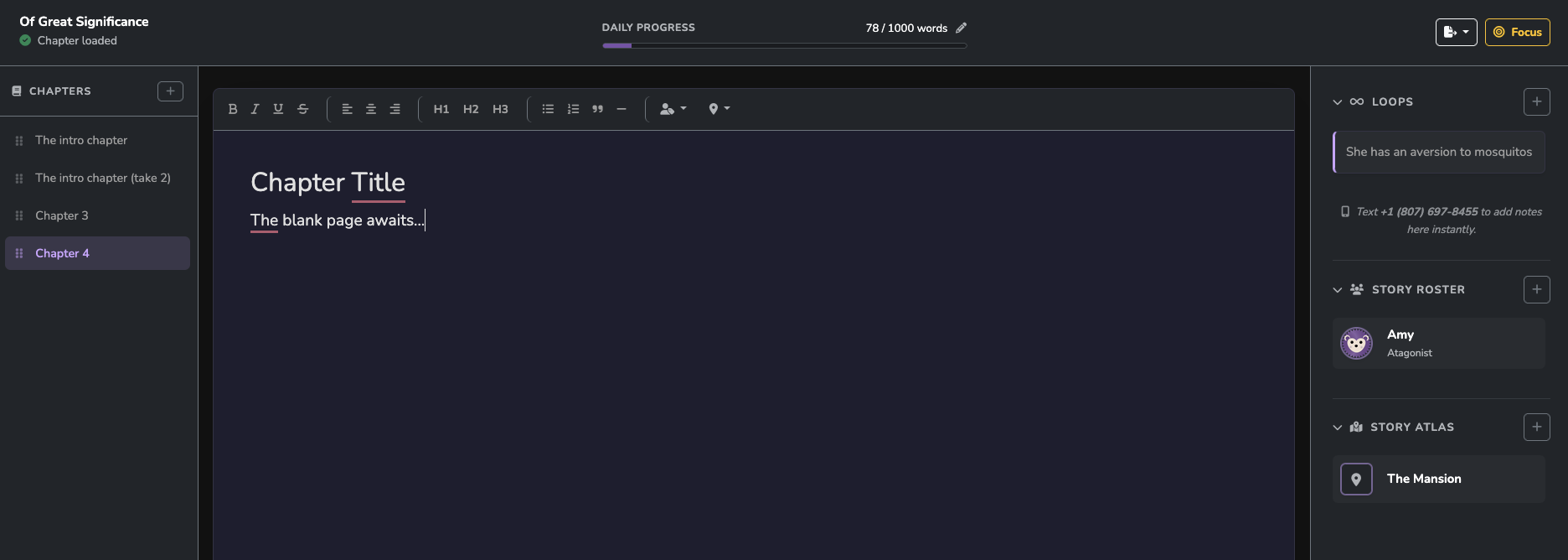
We get it. You've got Google Docs, Microsoft Word, and Scrivener. The world needs another word processor about as much as it needs a hole in the head.But here is the thing: Quill Loop is anything but another piece of writing software. It is ostensibly and proudly both more and less than that, in the most opinionated way possible.Let's get one thing out of the way right now. If you're looking for a word processor that lets you use 40 different frilly fonts and color-code your margins, Quill Loop is not the program for you. I know, it's weird hearing a SaaS company basically tell you to look elsewhere, but we aren't here to cater to everyone.We are here for the person who is ready to actually finish their novel. Let me show you why Quill Loop isn't a word processor—it's your Novel Writing OS.The Writer's Desk This isn't your standard blinking cursor on a blinding white background (first of all, dark theme, anyone?). This is a focused command center. Type @ to tag your characters directly into your sentences, or # to tag the current location. Create notes in the sidebar, start a Pomodoro timer, and enter full-screen focus mode. The Desk's one and only job is to give you exactly what you need to write, and then promptly get the heck out of your way.The Story Bible Once you hit your writing goal and your brain has turned to mush, head over to your Story Bible. Here is where you set up new realms, update character bios, and drop them in their last location so you know exactly where they are when you open the next chapter.The Infinite World Map & Relationship Web Are you juggling 20+ characters across 15 different locations and 5 plot lines? That's where Quill Loop shines. Worlds are infinitely nestable, letting you keep track of that specific tavern inside Castle Town. For characters, you can define complex webs of relationships—friends, romantic interests, mortal enemies. Effortlessly click through each node to visualize your cast's degrees of separation.The Loop Inbox Got ideas for the next round of writing while you're away from the keyboard? Text your custom Quill Loop phone number, and your thoughts will be dumped straight into your story's Inbox, waiting for you when you log back in.Multiplayer Accountability Some writers do their best work when they know they are being watched. Quill Loop lets you invite your friends via your custom penwith.me link so you can compete for the best writing streak, cheer each other on, and nudge each other to keep going. (Plus, you're immediately connected to me and the wider community—hello, by the way 👋).Your Characters Will Guilt-Trip You It's not just your friends watching you. Miss a day of writing? You'll get an impatient email from your protagonist wondering why she hasn't left the forest yet. Miss another? Expect the villain to text your actual phone asking how you expect him to escape the dungeon.Writing Insights Quill Loop tracks your real habits—from your most productive time of day to dynamically projecting the exact date you'll finish your draft.Can Google Docs do that? I didn't think so.Ready to stop messing with fonts and start writing? Head to [url='https://www.quillloop.com/register']QuillLoop.com[/url] and claim your desk today. Upgrade to Pro to get a 7-day free trial of the entire OS.And remember, the only difference between a dreamer and an author is the tap of keys or the stroke of a pen.
There is no way around it: writing has changed over the last few years, and one major driver is causing that change - AI.AI has, for better or worse, changed the very fabric of the world we live in. It has shaped the tools we use, the way we search, and for many, the way we write. People on both sides of the debate have decreed that writing is dead, pointing to endless tools producing books that nobody actually wrote, and few people want to read.But I think those tools are missing something distinctly human: creativity. Humans have the unique ability to look at a block of marble and say "what if," producing incredible works of art like David. We have the ability to look at a blank canvas and imagine the night sky as Vincent van Gogh did in 1889. Most importantly, we have the ability to look at a blank page, empty our souls, and create universes so vivid that you forget you are reading words and begin watching a play fabricated by your own mind.AI doesn't do these things. It doesn't think. It doesn't feel. At its core, it is a very large prediction engine that can only give you what it has seen before—no more, no less.Recently, other organizations have capitalized on the hype, deeply integrating this technology into their software stacks. But they miss the boat on what actually makes writing special. Authors spend hours poring over the perfect word to describe their character's terror, or to make their reader smile. There is no shortcut to this. No machine can reproduce human emotional intelligence.That's why I created Quill Loop and the Nanaimo Challenge.For years, thousands of writers would descend on their text editors every November. They worked frantically into the wee hours of the night, skipping showers and forgetting to eat, all in the name of forging a 50,000-word novel in 30 days. It was chaotic, messy, insane, and beautiful.That passion never went away, even as the tools and the corporate organizations changed. Nanaimo celebrates these writers in the best way possible: by getting out of the way and allowing them to write.Here is how we're fixing the 50k month:Guilt-Free Math: You're going to miss a day. Life happens. Quill Loop automatically recalculates your writing goal for the remaining days to keep you on track. No angry red warnings, just a clean, simple interface. Exceed your goal? Heck yeah! We celebrate that, and your daily goal drops to reflect your hard work.Prep Ahead: Don't waste time trying to remember Tom's hair colour. Assemble your characters and locations in advance. Your Story Bible keeps track of where they are, giving you instant access right from your writing desk so you can spend less time searching and more time drafting.Build Your Cabin: You don't need to do this alone. Invite your friends with your own custom penwith.me link to assemble a team and take on this lunacy together.Global Leaderboard: Write alongside the rest of the community and me, competing against the 50,000-word finish line.So what are you waiting for? Head to [url='https://nanaimochallenge.com']nanaimochallange.com[/url] now and join the waitlist. Your next great novel is 50,000 words away.And remember, the only difference between a dreamer and an author is the tap of keys or the stroke of a pen.
When a lot of writers start their first novel, they assume the process is pretty simple: you open your text editor of choice, type out "In the beginning..." (or some variant), hammer away at your keyboard for a few months, and then type "The End." Boom—you have a fully formed book.For some lucky people, that is very much the case. But for the vast, vast majority of us, unfortunately, it is not.For the non-superhumans, the flow usually looks a little more like this: You start your novel by typing out your intro. You might have one or two strong paragraphs introducing the main character, perhaps you introduce the antagonist, and then... right around chapter three or four, the flow begins to taper off. The ideas start to fade, and you hit the wall that most authors lovingly call writer's block.That big, impenetrable brick wall you just ran headlong into? That wall is what happens when your great idea for a novel just doesn't have enough plot.Usually, you have the beginning down, and some idea of what the climax should be. But the moment you sit down to write, you realize that the "pond" that is the middle of your book is actually an ocean. And instead of a sturdy ship, you've set sail on a life raft that is rapidly taking on water.So what should you do instead? Might I suggest taking your pants off?Okay, no, not literally—literarily! (Although studies have shown changing your environment can boost creativity, so do with that what you will.)Broadly speaking, when a writer sits down to pen a novel, they fall into one of two camps. The first is to just start cracking—writing the novel from start to finish with little or no idea what might happen beyond a vague concept. The writing community calls these authors "Pantsers" (writing by the seat of their pants), perhaps the most famous of whom is Stephen King.The problem with pantsing your novel is exactly what we discussed above. When you don't have a clear vision from the beginning, you might get a hundred pages in before you realize you don't know where to go—or worse, you don't like what you have.That brings us to the second kind of writer: The Outliner. The outliner is the novelist who lays out each chapter ahead of time. This can take many forms: bullet points, a brief summary, or a detailed scene-by-scene breakdown including the major beats and characters involved. The benefit of this strategy is that it gives you a clear idea of what your novel is going to be about before you start writing, and can highlight issues—like having a thin plot—way before page 50.The most common argument people have against outlining is that it puts your novel on guardrails, forcing you to follow a rigid structure instead of exploring where the writing takes you. While this argument seems reasonable at first, it falls flat pretty quickly. Just because you have an outline doesn't mean you can't (and won't) diverge from it in unexpected directions as you explore your story. Indeed, the outline will likely change many, many times as you discover what your story is actually about. Quite often, writers in the editing phase even employ a "reverse outline" to get a firmer understanding of their structure for exactly this reason.Another common misconception is that you have to be strictly one or the other. Here again, I must tell you this simply is not the case. Many writers have notes, post-its, and a sentence or two about the plot, and write around those. Others make a detailed outline and follow it to the letter. Still others make an outline and refer back to it only if they are stuck. Ultimately, the outline serves as a tool to assist you—no more, no less.So, should you stop pantsing? If you're finding yourself having trouble with the middle of your story, maybe give it a shot. An outline isn't a cage; it's a set of tracks to keep your story moving forward.If you're starting your next story, give Quill Loop a try. With a comprehensive character and world builder, coupled with a Writer's Desk that lets you sketch out your chapters and tag your characters dynamically, it is perfectly equipped to help you—whether you are a pantser, an outliner, naked, or anything in between!No matter what, just remember to keep on writing. The only difference between a dreamer and an author is the tap of keys or the stroke of a pen.
Don't lie. You and I both know you're guilty of this.You say you'll sit down to write as soon as the muse strikes. But when you finally sit at your desk, you suddenly realize you don't actually know what the inside of a 14th-century castle looks like. So, you do a quick Google search. Then you check an image on Instagram.Suddenly, it's an hour later. Your cursor is still blinking at the words "Once upon a time," and you've made zero progress. Another day wasted.Sound familiar? Trust me when I say you're not alone. You're reading this on a software platform I literally built from scratch to avoid writing my own novel. Honestly, it amazes me the things the brain will do to avoid putting words to paper.So, I have some bad news and some good news for you.The bad news is: you're never going to have that muse. Well, at least not often. You will have days where you can't wait to get to your desk—those days are precious, nurture them and take advantage - but they are exceedingly fleeting. Most days, you're going to drag yourself to the desk and sigh. Writing is a job, after all.So what's the good news? The good news is that your brain can be hacked.One of the easiest and fastest ways to do that is by creating a routine. Brains love routine; it's the fastest way to get a dopamine hit and build positive habits. The routine is simple: set a specific time each day that is your non-negotiable writing time. This doesn't need to be a massive block. We're not talking hours here, even 15 minutes counts.But when you do sit down, that time has to be ruthlessly productive. No scrolling, no "research," no checking what colour your protagonist's eyes were in Chapter 1. Fingers to the keyboard, words coming out. Details are for editing later, and trust me, there is plenty of time for that. Who cares if Nicole's eyes change from green to blue? That's what a proofreader is for. Who cares what the castle looks like? This is fiction. Make it yours and refine the realism later.Editing can only happen when you have the manuscript, just as sculpting can only happen when you have the marble.So, what should a focused writing session actually look like? Every writer is different, but here are the broad strokes of what has worked for the authors who actually cross the finish line:1. Choose a Dedicated LocationThe bulk of my first book was written in the local library. I chose that place because I never did any other activity there. No gaming, no day job, no scrolling social media. It was my dedicated writing space, and my brain quickly learned that when I sat at that specific desk, it was time to put words to paper.2. Kill the DistractionsKeep your space as distraction-free as possible especially your screen. Put your phone in another room. Put away the bills on your desk. Close your email, close Steam, and shut down Discord. This is your time. Make your editor full-screen and get typing.The Quill Loop Fix: We built a Focus Mode dedicated to exactly this. One click, and the entire UI fades away. No sidebars, no settings. Just you and the words.3. Come PreparedIf you like taking physical notes, make sure you have a sharp pencil and paper before you sit down. If you need a coffee, brew it first. Hunting for the things you need during your session breaks your focus, wastes your time, and is the ultimate enemy of a productive flow state.4. Write in SprintsWriting a book is a marathon, but your daily sessions should be sprints. If you have a long block of time, break it into 30-minute focus sessions followed by 5-minute breaks. This is known as the Pomodoro technique. It prevents burnout and gives you a micro-goal: write for 30 minutes, then you earn 5 minutes to play on social media.The Quill Loop Fix: The app features a native, built-in Pomodoro Timer that automatically triggers Focus Mode when the clock is running.5. Do Not ReviseIt doesn't matter if you spelled the hero's name wrong. It doesn't matter if you accidentally said it was night instead of day. This is the time to generate mass. Do not hit the backspace key, and do not break your flow for any reason.Once your writing session is completely over, then you can stop and re-read your passage. Fix the typos and double-check locations. But don't fret too much. Writing is about putting the pen to paper; editing is where you kill your darlings. Don't let perfect become the enemy of good.If you are struggling to get into a routine, or if your current messy web of Google Docs is slowing you down, you need to change your environment.Quill Loop keeps your entire Story Bible - your characters, locations, and notes - directly inside the text editor. You don't have to leave the page to remember how to spell Amaryll's name, because you can tag her directly in the text.Stop scrolling. Start writing. Head to QuillLoop.com and start your draft today.